

Most explainer films don’t stall in production. They stall between people.
The script waits in someone’s inbox. Feedback arrives in four threads, two of them about an older version. Legal sees the final cut on the day it was meant to go out. And once it’s finally approved, someone still has to cut it for LinkedIn, add subtitles, find a thumbnail and write the post.
None of that is making the film. It’s everything around it, and it’s where most of the time goes.
Where films actually get stuck
Ask any marketing team about their last video and the same questions come up:
“Which version is this?”
“Did legal see the new script?”
“Who said the logo could be that small?”
“Can someone send me the square one for LinkedIn?”
Each one costs a day, sometimes more. Multiply it by everyone who needs to see the film, and a two-week job takes six.
What it really costs
Time is the obvious cost. The hidden ones are worse.
A film goes out with a claim legal never saw, because they approved an older version. A brand drifts, because every film is briefed from scratch by whoever is free. A campaign misses its moment, because the portrait cut for LinkedIn arrived a week after the landscape one.
And the people who should be thinking about the message spend their week chasing files instead.
What good looks like
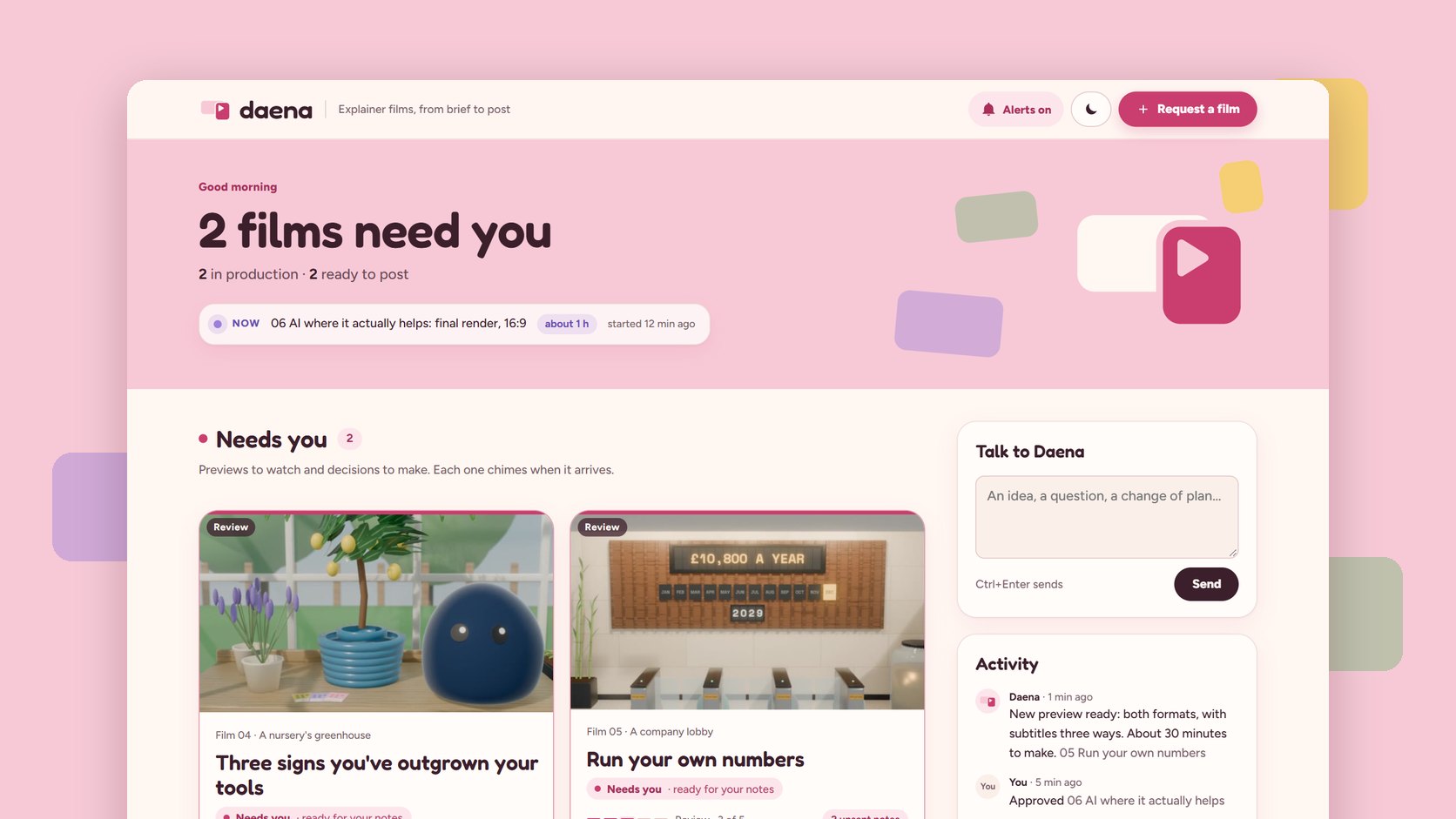
One place for the whole film
The brief, the script, the voice, every preview and every note live together, in order. Nobody hunts through email for “the latest”.
Notes pinned to the moment
Feedback is attached to the exact second, and the exact cut, it’s about: “0:31 in the square version, the price comes in late.” Not “around the middle, the bit with the chart”.
Approvals from the people who can give them
Everyone who needs to see a film can see it. Only the people you name can approve it, and every approval is recorded: who, when, and which version.
Always clear whose turn it is
Every film sits in one of three places: waiting on you, being made, or ready to post. Nothing sits quietly in someone’s inbox.
Done means ready to post
A finished film isn’t one file. It’s the right cut for each platform, subtitles where feeds play on mute, a thumbnail, a title, the post itself and the alt text, each ready to copy.
Where AI fits
AI is very good at the slow parts of making a film: a first draft of the script, a natural voice-over, a preview in every format. Used well, it turns weeks into days.
It shouldn’t decide what your brand says, or whether a film is right. The best set-ups let people decide at every step, with the heavy lifting in between done for them: each where it works best.
A checklist for your next film
Before the next one starts, answer four questions:
“Where will the feedback live?”
“Who can approve it, and how will we know they did?”
“Which version did legal see?”
“Which cuts, subtitles and posts does each platform need?”
If the answer to any of them is “somewhere in email”, the film will take longer than it should.
| Over email | In one place | |
|---|---|---|
| Feedback | Across several threads, about different versions | Pinned to the moment and the cut, on the current preview |
| Approval | A thumbs-up somewhere in a thread | From named approvers only, recorded with the version |
| Where it’s up to | Ask around | Needs you, in production, or ready to post |
| Formats | Asked for one at a time, after sign-off | Every cut made with the film |
| Posting | Written on the day | Titles, posts, subtitles and alt text ready to copy |
One place for every film
This is the problem Daena was made to solve. Daena is an AI-powered platform where your marketing team, the people who sign things off and the film itself come together, from the first brief to a post on every platform. Your people make every decision; Daena does the heavy lifting.
If your team makes films, or wants to, and everything around them takes longer than the films themselves, it’s worth a conversation.